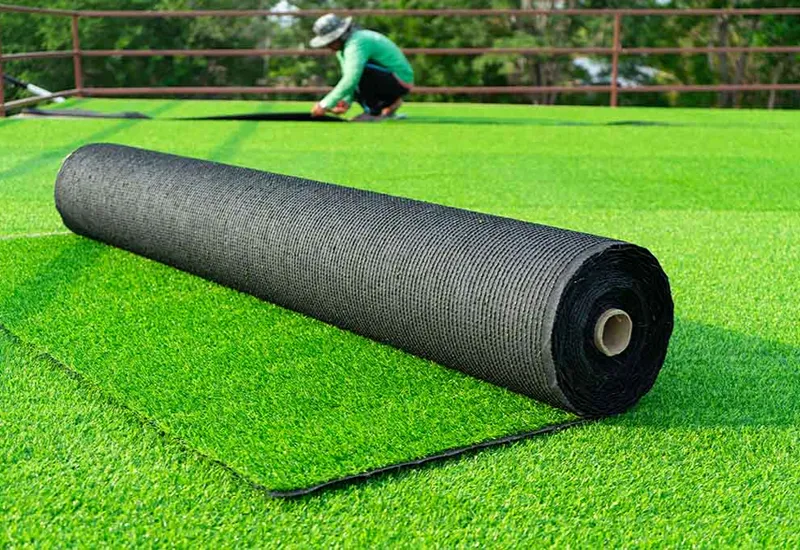


Artificial grass is made from synthetic pile fibres tufted into a backing and secured with a secondary coating. The visible blades are usually polyethylene (PE), polypropylene (PP), nylon (polyamide), or a blend. Beneath them, the complete turf system may also include curled thatch, sand or performance infill, a shock pad, drainage layers and a prepared base.
Two products can both use PE blades yet perform differently because of their yarn shape, density, backing, infill and installation. One polymer name is not a complete quality grade.
Artificial Grass Is a Complete Turf System
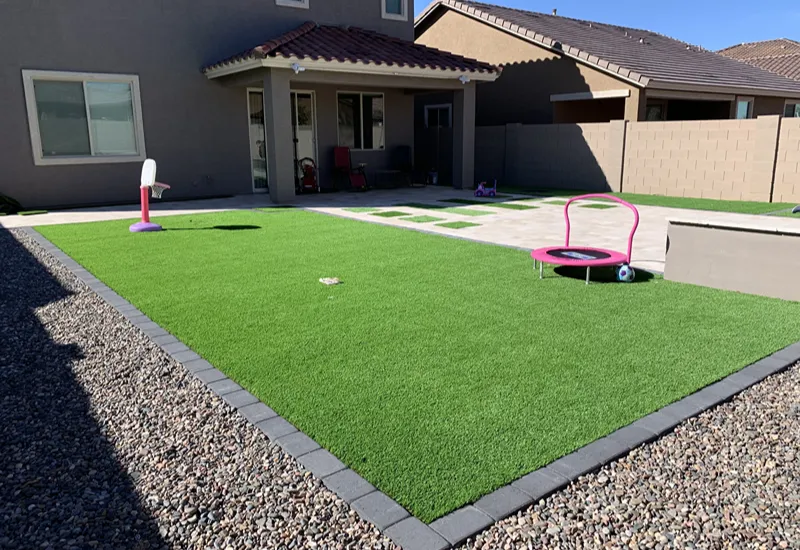
The green surface is only the top layer. Tufting machines stitch straight blades, curled fibres or fibrillated tape through a primary backing. A secondary coating helps lock the tufts in place.
Depending on the product and setting, an installed system can contain:
- Pile yarn: the upright blades that create the main colour, feel and appearance.
- Thatch: shorter, curled fibres that add body and help support the pile. The thatch may use a different polymer or shade.
- Primary backing: usually a woven or non-woven textile, commonly PP and sometimes polyester, that holds the tuft pattern.
- Secondary coating: often latex or polyurethane (PU), applied to secure the tufts.
- Infill: sand or another material placed between the blades for ballast, support or sport-specific performance.
- Underlayers and base: a shock pad, drainage layer, geotextile or compacted aggregate, selected for the site.
Not every installation uses every layer. A balcony roll, a family garden, a playground and a football surface have different demands. This is why a supplier should assess the intended use as well as the turf sample.
Polyethylene, Polypropylene and Nylon Compared
PE, PP and nylon are the main fibre families found in artificial turf. Each can be engineered in different forms, so the comparison below describes common tendencies rather than guarantees.
| Fibre | Typical feel and behaviour | Common roles | Points to check |
|---|---|---|---|
| Polyethylene (PE) | Generally softer and more flexible, with a lawn-like appearance; usually balances comfort and durability well | Landscape pile, play-oriented surfaces and many sports systems | Yarn thickness and shape, density, recovery after traffic, UV-weathering evidence and warranty terms |
| Polypropylene (PP) | Can be fine and lightweight; thin PP pile generally flattens more readily under repeated traffic | Curled thatch, primary backing, decorative turf and some lower-demand pile | Whether it is used as pile or thatch, expected foot traffic, heat exposure and construction quality |
| Nylon / polyamide (PA) | Generally stiffer, springier and more abrasion-resistant; can feel harsher than PE | Putting or practice surfaces, high-wear and specialist applications | Surface feel, heat exposure, moisture behaviour, intended sport or use, and product-specific test data |
There is no universally best fibre. Soft PE may suit a garden, firmer nylon a practice area, and PP supportive thatch or backing. The setting and complete construction decide.
Polyethylene: Softness With Versatility
Polyethylene is widely used for modern landscape and sports pile because it can be made soft, flexible and natural-looking. It absorbs very little water, but that describes the fibre only. Water can still remain in infill, beneath seams, in an underlay or on a base that lacks a clear drainage route.
PE is generally softer than nylon and more resilient than fine PP pile in comparable use. It can still split, flatten or become brittle. Blade profile, yarn thickness, additives, density, traffic and maintenance all affect performance.
Polypropylene: Useful Beyond Economy Turf
Polypropylene appears throughout a turf product. It is common in the primary backing and curled thatch, and it is also used for some pile yarns. It takes up little moisture and can be made into fine, lightweight fibres.
PP is often associated with lower-cost or lower-traffic surfaces, but polymer alone does not establish price or quality. On a busy walkway, thin PP pile may not recover as well as a more robust PE or nylon construction.
Nylon: Firmness and Recovery
Nylon, also called polyamide, is generally the stiffest and most resilient of the three fibre families. It can provide strong spring-back, abrasion resistance and dimensional stability. Those qualities explain its use in specialist, practice and high-wear surfaces.
The trade-off is a firmer feel and potentially more skin friction. Nylon absorbs more moisture than PE or PP. Its resistance to heat-related deformation does not mean it stays cool or is immune to Dubai weather.
Fibre Type Is Only One Part of Quality
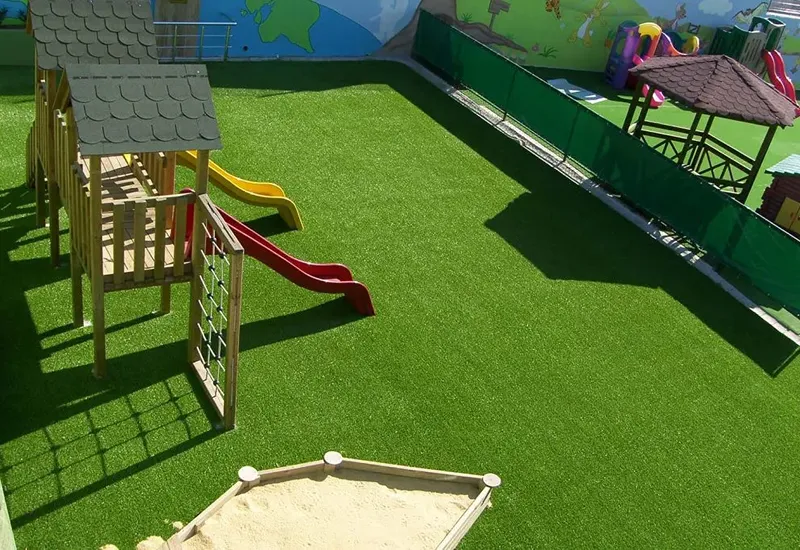
The polymer label does not tell you how a surface will feel underfoot or recover after furniture and foot traffic. Ask about the product’s construction as well:
- blade shape, such as flat, C-shaped, S-shaped, ribbed or diamond profiles;
- yarn thickness, denier and any polymer blend;
- pile height, stitch rate, gauge, density and face weight;
- monofilament blades versus fibrillated or tape yarn;
- the balance of straight pile and curled thatch;
- tuft bind and backing stability;
- infill and underlay requirements;
- brushing, cleaning and maintenance needs.
Taller pile is not automatically more durable. A dense, long pile can still mat when its yarn or maintenance routine does not suit the traffic. When comparing residential artificial grass, handle samples, brush them in both directions and ask how the complete product is expected to behave in the intended setting.
Backing, Coating and Drainage
The primary backing sets the textile structure and tuft spacing. A secondary latex or PU coating helps anchor the tufts. Neither coating is automatically superior: formulation, curing, seam adhesion and ageing all matter.
Drainage depends on a continuous route, not on the blades being water-resistant. Water may pass through perforations or an open backing, then through the layers below. It can still pool if adhesive blocks the openings, a balcony outlet is covered, the floor has no suitable fall or the sub-base is impermeable.
For balcony artificial grass, check the existing waterproofing, drainage outlet, edge details and access for cleaning before selecting the roll. On soil, base preparation and falls are equally important. A professional artificial grass installation should treat seams, adhesive and drainage as connected parts of the system.
What Infill Does
Infill sits between the fibres. Silica sand can add ballast and help support blades. Sports systems may use rubber, TPE, EPDM, cork or other specified materials to influence traction, impact response and ball behaviour. Some landscape products need little infill, while certain long-pile sports systems depend on a controlled depth.
The choice can affect heat, dust, odour, maintenance and end-of-life processing. “Cooling”, “pet-safe” or similar labels need product-specific evidence. Soft pile does not prove fall protection; playground impact performance belongs to the tested installed system.
What the Materials Mean in Dubai
Artificial turf can become much hotter than natural grass in direct sun. Shade, wind, fibre design, infill, moisture and nearby paving all affect temperature; polymer alone cannot predict it.
UV stabilisers can slow degradation and colour change. They do not cool turf, prevent all fading or establish an exact lifespan. Ask for product-specific weathering evidence and warranty terms. Check the surface before bare feet, children or pets use it on a hot day.
For pet areas, low-absorption PE or PP fibres do not prevent urine odour. Liquid can remain in infill, backing, seams or the base. A clear drainage path, accessible rinsing and compatible maintenance matter more than a broad fibre claim. See artificial grass for pets for setting-specific options.
How to Choose by Setting
Gardens and Family Landscaping
PE is common for a softer, lawn-like surface. Check pile recovery, sun exposure, seams and base drainage. For play zones, assess the complete product and underlay, not only softness.
Balconies and Terraces
Prioritise drainage access, secure edges, manageable pile under furniture and existing waterproofing. There is no single balcony polymer; traffic, furniture and heat exposure guide the choice.
Pets
Choose a construction that can be rinsed and drains through every layer. Check edges, cleaner compatibility and temperature. Fibre strength is not a hygiene or safety certificate.
Sports and Practice Areas
Select sport turf as a system: pile, backing, infill, shock pad, base, maintenance and verified test status. The artificial turf sports guide explains how requirements vary. A certificate for one system does not cover every supplier product.
Can Artificial Grass Be Recycled?
PE, PP and some nylon can be recycled in suitable streams. Used turf is harder to process because yarn, backing, coating, adhesive, seam tape, infill and debris may need separation.
Specialist facilities can recover useful materials, but local acceptance is not automatic. Ask who collects the surface, where it goes, whether infill is recovered and what confirms its destination. “Recyclable” and “recycled into new turf” are different claims.
Frequently Asked Questions
Is artificial grass made entirely from plastic?
Its fibres and backing are usually made from synthetic polymers, but an installed system can also contain mineral sand, plant-derived infill, adhesives, coatings, a shock pad and an aggregate base. The exact material stack varies by application.
Does UV-stabilised artificial grass stay cool and never fade?
No. UV stabilisation slows weathering and colour change; it is not a cooling treatment or a no-fade guarantee. Shade, airflow, surface construction and surrounding materials also affect heat.
Is PE always better than PP or nylon?
No. PE is generally softer, nylon is generally more resilient, and PP is useful in thatch, backing and some pile products. Construction, installation and intended use determine which combination is suitable.
Choose the Whole System, Not Just the Fibre
Artificial grass is made from more than its visible green blades. PE, PP and nylon each bring different tendencies, but backing, coating, infill, base preparation, drainage and maintenance shape the finished result.
If you are planning artificial grass in Dubai, compare complete specifications and samples for your actual setting. Dubai Artificial Grass can help you assess the surface, drainage route, expected traffic and installation requirements before recommending an appropriate system.